
When a child loses a baby tooth earlier than expected, keeping that space open becomes essential for proper alignment of future permanent teeth. This is where appliances like the transpalatal arch space maintainer vs nance come into consideration. Many parents hear these terms during an orthodontic consultation and naturally wonder what the difference is—and which option is better for their child.
In pediatric dentistry, choosing the right appliance depends on how a child’s mouth is developing, where the space is located, and how much control is needed. As a pediatric dentist in dubai, I often explain that both appliances serve a similar purpose, but they work in slightly different ways and are used in different clinical situations.
If your child has been recommended a space maintainer for baby teeth, understanding these options can help you feel more confident about the treatment plan.
Not sure which space maintainer your child needs?
Transpalatal Arch Space Maintainer vs Nance: Which One Is Better for Children?
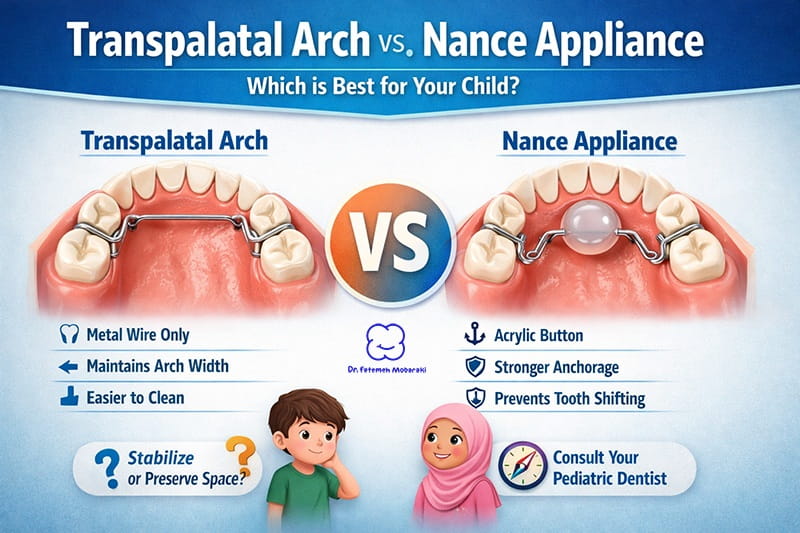
When comparing a transpalatal arch space maintainer vs nance, the right choice depends on how much support your child’s teeth need to maintain proper spacing. Both appliances are effective, but they serve slightly different clinical purposes.
In many cases, parents searching for transpalatal arch space maintainer vs nance are simply trying to understand whether their child needs a more supportive appliance or a lighter preventive option. A proper clinical evaluation helps determine this with accuracy.
In practical terms, a transpalatal arch is usually chosen when the goal is to stabilize molars and maintain arch width, while a Nance appliance is preferred when there is a higher risk of space loss and stronger anchorage is required.
For example, if a child loses a primary molar early and there is a concern that surrounding teeth may shift forward, a Nance appliance often provides better control. On the other hand, if spacing is still relatively stable, a transpalatal arch may be sufficient and more comfortable.
Understanding the transpalatal arch space maintainer vs nance decision is not about choosing the “stronger” appliance—it’s about selecting the one that matches your child’s growth pattern and orthodontic risk.
in short:
- TPA = stabilization and width control
- Nance = stronger anchorage and space preservation
What Is the Difference Between Nance and Transpalatal Arch?
The difference between nance and transpalatal arch lies primarily in how they interact with the palate and how much resistance they provide.
A transpalatal arch does not press against the palate. It allows for easier cleaning and is generally more comfortable for children. It’s often used when mild control is needed.
The Nance appliance includes an acrylic pad that sits on the palate. This creates resistance against molar movement, making it more effective when space loss is a concern.
Key differences parents should understand:
- Comfort: TPA is usually less noticeable
- Anchorage strength: Nance provides stronger support
- Hygiene: TPA is easier to clean around
- Indications: Nance is preferred when preventing forward drift is critical
Transpalatal Arch vs Nance Appliance: What Should Parents Know?
When comparing a transpalatal arch vs nance appliance, parents are usually trying to understand how these two options differ in everyday use. Both are fixed appliances used in the upper jaw, but they vary in how they support the molars and maintain space. A transpalatal arch focuses more on stabilizing tooth position and maintaining arch width, while a Nance appliance provides stronger anchorage by using an acrylic button against the palate.
In practical terms, the choice between a transpalatal arch vs nance appliance depends on how likely it is that teeth will shift into the empty space. If the risk is low, a lighter appliance like a transpalatal arch may be enough. If the risk is higher, the added support of a Nance appliance becomes more important.
When Does a Child Need a Space Maintainer?
A child may need a space maintainer when a baby tooth is lost too early due to decay, trauma, or extraction. Without guidance, neighboring teeth can drift into the empty space, potentially causing crowding or misalignment later.
This is where early intervention in pediatric dentistry becomes important. In Dubai, where parents are increasingly proactive about oral health, timely placement of space maintainers helps reduce the need for more complex orthodontic treatment in the future.
A dentist may recommend an appliance if:
- A primary molar is lost prematurely
- There is visible space closure beginning
- The child is still years away from permanent tooth eruption
How Does a Transpalatal Arch Work?
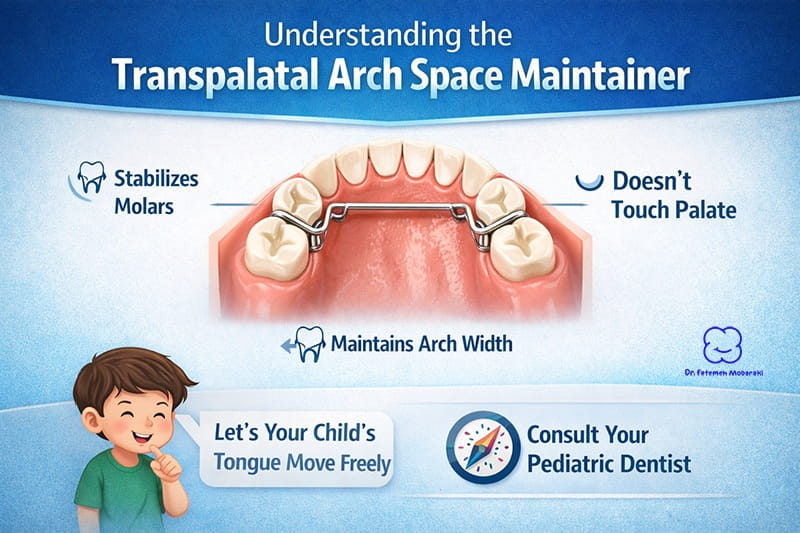
A transpalatal arch works by connecting the upper molars and stabilizing their position. It prevents rotation and maintains the width of the dental arch.
Because it does not press against the palate, it allows natural tongue movement and is generally well tolerated by children.
It is often used when:
- The goal is to maintain arch width
- There is minimal risk of molar drifting forward
- Orthodontic guidance is preventive rather than corrective
How Does a Nance Space Maintainer Work?
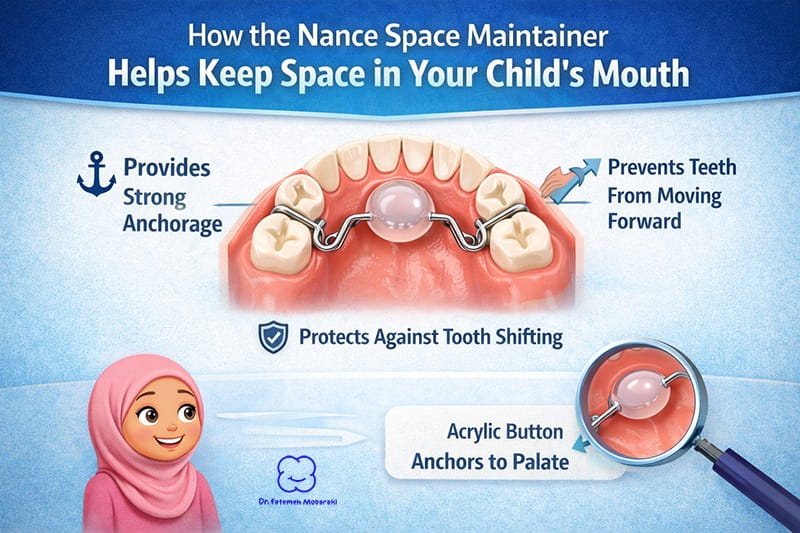
The nance space maintainer vs TPA comparison becomes clearer when looking at how the Nance appliance functions.
The acrylic button on the palate acts as an anchor point. It resists forward movement of molars, especially when space has already started to close or when multiple teeth are missing.
This makes the Nance appliance more suitable for:
- Preventing significant space loss
- Cases with higher orthodontic risk
- Situations requiring stronger anchorage
However, because the acrylic rests on soft tissue, it requires careful hygiene to avoid irritation or plaque buildup.
Which One Is Better for My Child?
There is no universal “better” option between a transpalatal arch and a Nance appliance. The decision depends on your child’s specific dental condition.
A pediatric dentist evaluates:
- Age and stage of dental development
- Location of the missing tooth
- Risk of space loss
- Oral hygiene habits
For example:
- A child with good spacing and low risk may benefit from a TPA
- A child with crowding risk may need the added stability of a Nance appliance
In some cases, additional treatments such as dental crowns for 5 year old patients may also be considered to preserve tooth structure and prevent early tooth loss in the first place.
Are These Appliances Comfortable for Children?
Most children adapt quickly to both appliances. Initial awareness is normal, but discomfort is usually mild and temporary.
With a transpalatal arch:
- Speech is minimally affected
- Eating feels normal after a few days
With a Nance appliance:
- The palate may feel slightly pressured at first
- Sticky foods may need to be avoided
Parents often notice that children forget about the appliance within a week or two.
How Should Parents Care for These Appliances?
Good oral hygiene is essential, especially with fixed appliances.
For both types:
- Encourage brushing around molars and wires
- Avoid sticky or hard foods
With a Nance appliance:
- Pay extra attention to cleaning around the acrylic button
- Rinse after meals to prevent buildup
Diet also plays a role. Reading about Foods to Avoid With a Space Maintainer can help prevent damage or complications.
How Long Does a Child Need to Wear It?
The duration depends on when the permanent tooth is expected to erupt.
Typically:
- A few months to a couple of years
- Regular dental check-ups monitor progress
Once the permanent tooth begins to emerge, the appliance is removed.
Can These Appliances Prevent Future Orthodontic Problems?
Yes, in many cases they significantly reduce the risk of crowding and misalignment.
By preserving space:
- Teeth erupt in more natural positions
- The need for complex orthodontic treatment may be reduced
However, they do not eliminate the need for orthodontics entirely. They are part of a broader preventive strategy.
Parents who want a clearer understanding can read Types of Space Maintainers to see how different appliances are used in children.
Expert Insight
Clinical evidence supports the use of fixed space maintainers in managing premature tooth loss in children. Appliances like the transpalatal arch and Nance are selected based on anchorage requirements and growth patterns. Their effectiveness depends on timely placement, proper fit, and consistent follow-up.
How Does This Fit Into Pediatric Dental Care in Dubai?
In a city like Dubai, where access to specialized pediatric dental care is readily available, early diagnosis and preventive treatment are increasingly common.
Dentists focus not only on treating problems but also on guiding proper oral development. In some cases, children with anxiety may benefit from supportive approaches such as sedation dentistry for kids, ensuring that treatments like appliance placement are stress-free.
Understanding options like Space Maintainer vs Space Regainer can also help parents see how early intervention compares to later corrective treatments.
Dr. Fatemeh Mobaraki often emphasizes that maintaining space early is far simpler than correcting crowding later.
Conclusion
Choosing between a transpalatal arch and a Nance appliance comes down to your child’s individual needs. Both are reliable tools in pediatric dentistry, designed to protect space and support healthy dental development.
The key differences lie in how they function:
- Transpalatal arch: lighter, more comfortable, used for stabilization
- Nance appliance: stronger anchorage, used when space preservation is critical
For parents, the most important step is early evaluation. With the right approach, these small interventions can make a meaningful difference in how a child’s smile develops over time.